



I was sitting in my kitchen after yet another failed run at Spanish, grammar books stacked on the table and sticky notes on just about everything, when it finally clicked. My problem was never motivation. I was learning like it was still 1995. So I did the slightly unhinged thing: I downloaded 10 language apps, paid for premium with my own money, and lived with them for 3 months, until my phone started complaining about storage.
The best app to learn Spanish in 2026, after my test, is Lingopie (9.3/10). You learn from real TV from Spain and Latin America with clickable subtitles, and it was the only app that made me forget I was studying.
Total beginner or zero budget? Start with free Duolingo (8.4) and move to Lingopie once you know a few hundred words. Want grammar served in order? Babbel (8.3).
In shortKey takeaways5 points
- Lingopie won by 0.9 points. I understood simple conversations after about 3 weeks and could follow series after 2 months.
- Duolingo's free version is enough. I would not pay for Super.
- Spain or Latin America matters: Babbel, Memrise, Drops and Rosetta Stone let you choose, Duolingo leans Latin American.
- Rosetta Stone was the greediest app in the test and came 9th.
- Cheapest strong combo: free Duolingo for the first 500 to 1,000 words, then Lingopie at $6.99 a month on the yearly plan.
My quick picks, if you only have a minute
Ten apps is a lot of scrolling. If all you want is a name before your coffee gets cold, these are the four I would hand to a friend, and each one suits a different kind of learner. The long version, with prices and the Spain or Latin America question, follows right after.
Four picks from three months of testing
Best overall: real Spanish from TV
Lingopie, 9.3/10
Learn from shows like La Casa de Papel. $6.99 a month on the yearly plan at the time of writing, 7-day free trial.Best free start for total beginners
Duolingo, 8.4/10
The free version does the job. Skip the paid plan.Best for grammar in a clear order
Babbel, 8.3/10
Short teacher-made lessons, with separate Spain and Latin American courses.Best for learning while you drive
Pimsleur, 8.1/10
Thirty-minute audio lessons. Nothing to look at, which is the point.
All ten Spanish apps on one page
Here is the whole test in one table. The “Spanish taught” column is the part most rankings skip, and for a Spanish learner it can matter more than the price. More on that a bit further down.
| App | Score | Price | Free option | Spanish taught | Best for |
|---|---|---|---|---|---|
| 1. Lingopie | 9.3/10 | $83.88/yr | 7-day trial | Spain and Latin America | A2 to B2, series lovers |
| 2. Duolingo | 8.4/10 | Free, Super about $84/yr | Yes, the whole course | Leans Latin American | Total beginners |
| 3. Babbel | 8.3/10 | About $107.40/yr | First lesson | Separate Spain and LatAm courses | Grammar in order |
| 4. Pimsleur | 8.1/10 | About $19.95/mo | First lesson | Latin American, Castilian sold separately | Drivers and commuters |
| 5. Mondly | 7.2/10 | About $10 to $12/mo | Limited | Not clearly stated | Chatbot practice |
| 6. Busuu | 6.9/10 | About $5 to $14/mo | Yes | Leans Spain | Writing corrected by natives |
| 7. Memrise | 6.8/10 | About $60/yr | Yes | Spain or Mexico course | Vocabulary and real voices |
| 8. Drops | 6.5/10 | About $10 to $13/mo | 5 minutes a day | Castilian or Latin American | Vocab in tiny bites |
| 9. Rosetta Stone | 6.0/10 | $159/yr | Limited | Spain or Latin America | Very patient people |
| 10. Clozemaster | 6.0/10 | About $12.99/mo | Yes, very usable | Mixed, not labelled | Intermediate grinders |
My scores for ten Spanish apps
Out of 10, after at least 14 days of daily use each
- 1. Lingopie9.3
- 2. Duolingo8.4
- 3. Babbel8.3
- 4. Pimsleur8.1
- 5. Mondly7.2
- 6. Busuu6.9
- 7. Memrise6.8
- 8. Drops6.5
- 9. Rosetta Stone6.0
- 10. Clozemaster6.0
The average across all ten is 7.35, and only 4 apps cleared 8. Look at the top, though. Lingopie sits 0.9 points ahead of Duolingo, while Duolingo, Babbel and Pimsleur are bunched together within 0.3 of each other. That gap is the whole story of this article.
How I tested ten Spanish apps
Every app got at least 14 days of daily use, squeezed into normal life: with the morning coffee, on the bus, at lunch, at the gym, and late at night when I could not sleep. I paid for every premium plan myself. Nobody sent me a free account, and nobody saw this ranking before you did.
What I scored them on
- How long my motivation lasted before opening the app felt like a chore.
- Whether I learned Spanish I could use in a conversation, not just inside the app.
- Value for money, compared with the other nine.
- Whether it frustrated me more than it helped.
And then one question sat above all of them: would I keep using this app if nobody had asked me to write about it? That one question sorted the list faster than any spreadsheet.
What a good Spanish app feels like
You want to open it. Nobody has to nag you. The game parts are there to help, and they should never feel like a part-time job. It teaches Spanish you would need in a shop in Barcelona or when ordering a coffee in Mexico City, not robot phrases like “el elefante come manzanas”. And it fits how you learn: some people love drills, I love stories.
Spain or Latin America: which Spanish does each app teach?
The Spanish in Madrid and the Spanish in Mexico City are the same language, the way British and American English are. A Mexican and a Madrileño understand each other just fine. But the differences show up fast in an app, and they can be confusing if you switch between two apps that disagree.
- Vosotros. Spain uses it for “you all” with friends. Latin America uses ustedes for everyone. An app that skips vosotros leaves a hole if you are heading to Seville.
- Sound. In much of Spain the “c” in gracias sounds like the “th” in “think”. In Latin America it is an “s”.
- Everyday words. A car is a coche in Spain and a carro in Mexico, juice is zumo or jugo.
My own Spanish itch came from watching Kurt Caz travel through Latin America, so I lean that way. If your trip is to Spain, pick an app that lets you choose. And if you end up in Cuba, no app on earth fully prepares you, as anyone who has watched Bald and Bankrupt try to get by in Havana will know.
1. Lingopie: the winner that changed everything
- Best for
- A2 to B2, series lovers
- Price
- $83.88/yr
- Spanish taught
- Spain and Latin America
I found Lingopie by accident. “Bella Ciao” got stuck in my head after a party, I tracked down the show it came from, and before I knew it I was watching La Casa de Papel with clickable Spanish subtitles. I was scared an app would ruin the show. It did the opposite. The whole story is in my full Lingopie review; here is the short version for this ranking.
How Lingopie teaches Spanish
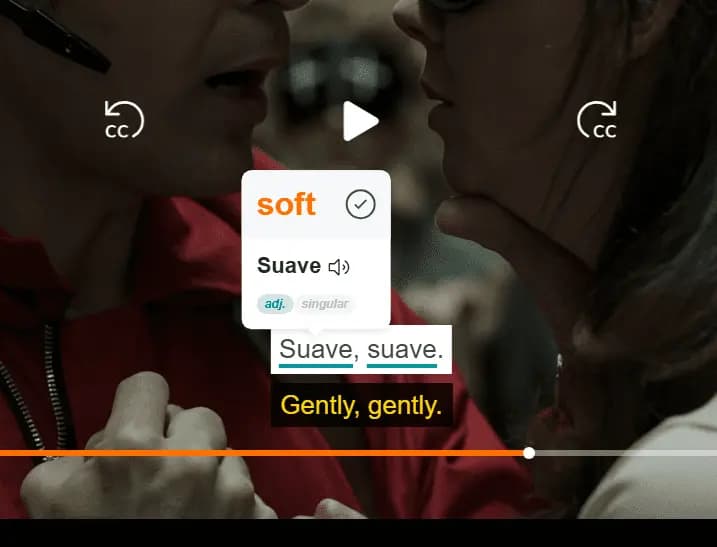
You watch real series and films with Spanish and English subtitles stacked on top of each other. Click any word and you get the translation and the audio. Save it, and it turns into a flashcard that keeps the scene attached. The word entrar is still tied, in my head, to the moment the Professor says they will enter the Banco de España. You do not learn words in a vacuum. The app also notices which words you keep stumbling over and brings them back.
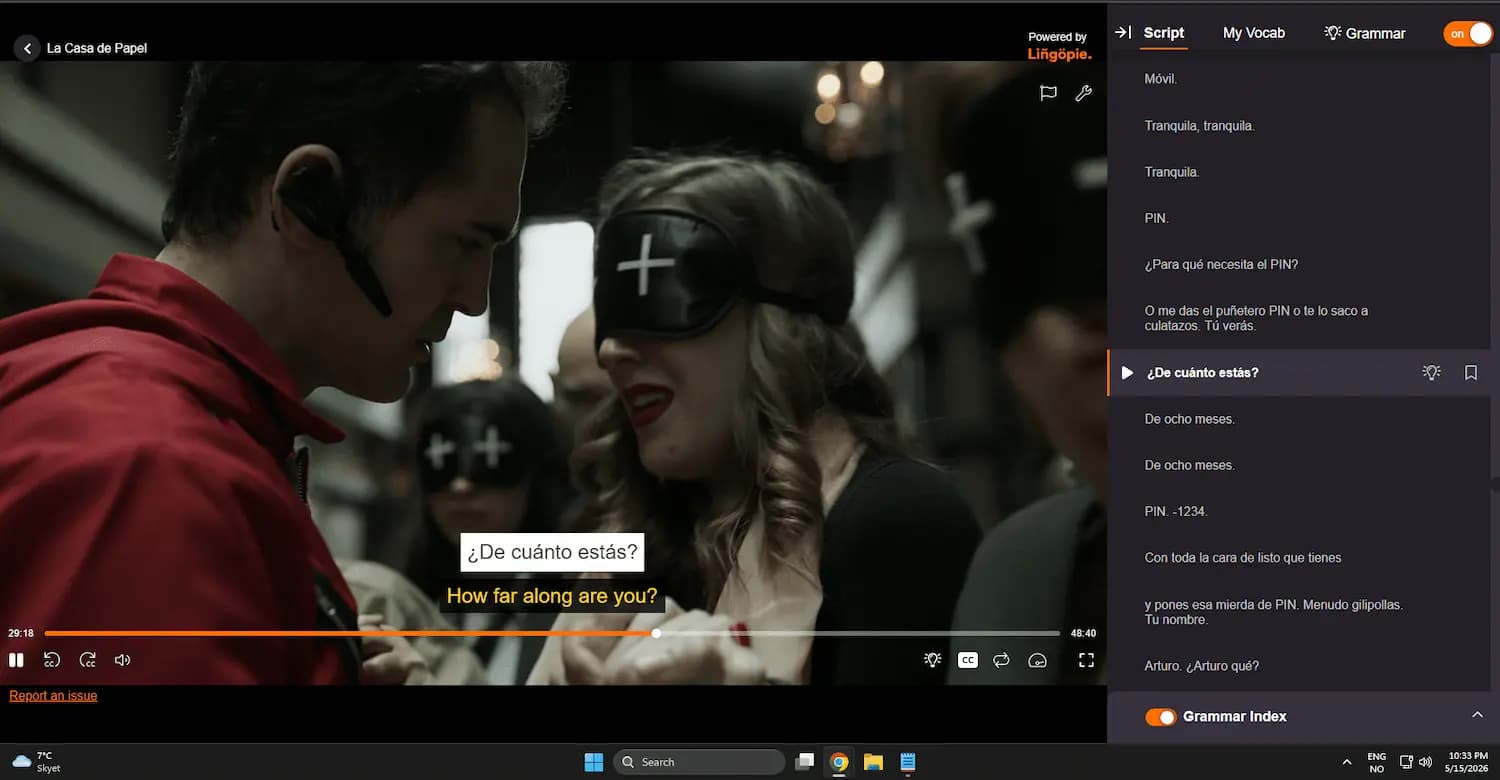
I almost always used it on my PC. The big screen leaves room for both subtitle lines, and the Chrome extension puts the same clickable subtitles on top of selected Netflix shows. On the phone I mostly reviewed saved words at the bus stop.
Spain, Latin America, or both?
Both, and this is a big reason it sits at the top for Spanish learners. Spanish is Lingopie's largest catalog, with shows from Spain like La Casa de Papel and Vis a Vis next to telenovelas, comedies and travel shows from Latin America. There are “Best of Spain”, “Best of Mexico” and “Best of Colombia” collections, and a country filter if you only want one accent.
What it costs, and what it gave me
At the time of writing the yearly plan is $83.88, which works out to $6.99 a month. A 3-month plan is $41.97, so four of those would cost you $84 more than the yearly plan. There is a lifetime plan at $229, which only beats the sale price on the yearly plan after about 2.7 years. There is no monthly plan on the website, and the 7-day trial needs a card, so set a reminder for day 6 if you are only testing.
What did I get for it? After about 3 weeks I understood simple conversations. After 2 months I could follow a series without pausing every five seconds. I also booked Lingopie's live group lessons on Zoom, small classes on topics like “If I had Magic Powers”, and they might be the most underrated thing I have seen in a language app. Lingopie now sells group lessons as their own plan with the first lesson free, so check the current terms in your account.
Lingopie treats your intelligence with respect.
Why it won
- You hear Spanish the way people speak it, not textbook Spanish
- My motivation stayed sky high for the whole test
- Words stick because they come with a scene, no cramming
- It learns from your mistakes and brings weak words back
Where it falls short
- Fewer languages than the big players (15+), though Spanish is its strongest
- Needs more active screen time than a five-minute app
- Not for total beginners, and no step-by-step syllabus from day one
- The AI translations slip now and then
2. Duolingo: the charm that won't make you fluent
- Best for
- Total beginners
- Price
- Free, Super about $84/yr
- Spanish taught
- Leans Latin American
Duolingo is where almost everyone starts, and for a complete beginner that is the right call. It is fun, it is free, and the little owl is very good at getting you back the next day. After a while, though, the streak reminders start to feel like mild threats. And the longer I used it, the clearer it got: you become very good at Duolingo, and not always as good at Spanish.
How Duolingo teaches Spanish
A path of bite-size units, each one a string of short exercises: match the words, fill the gap, listen and type. Old words come back later through spaced repetition, which works. My Spanish score in the app sits at 19, which Duolingo says means I can introduce myself. Cute, and about right. What you do not get much of is real conversation, and some of the sentences are strange enough to make you laugh on the bus.
Which Spanish Duolingo teaches
The English to Spanish course leans Latin American, and at the time of writing it largely leaves vosotros out. Fine for Mexico or Colombia. Heading to Spain? Plan to pick up vosotros somewhere else.
Should you pay for Duolingo Super?
No. The free version has ads and limits, and it still gives you the whole course. It is not a greedy app, which I respect. Super costs about $12.99 a month or about $84 a year at the time of writing (some people report up to $119.99 a year), and Max with its AI video calls is about $29.99 a month. I would put that money toward Lingopie instead. I go deeper in my full Duolingo review for Spanish, and if you are wondering whether Duolingo alone is enough to learn Spanish, I wrote a whole piece on where it stops.
What I liked
- The free version is complete
- Fun enough to build a daily habit
- Lots of languages to choose from
What bugged me
- Very little conversation practice
- Feels more like a game than a course after a while
- Odd sentences nobody would ever say
3. Babbel: the serious student
- Best for
- Grammar in order
- Price
- About $107.40/yr
- Spanish taught
- Separate Spain and LatAm courses
If Duolingo is the fun younger sibling, Babbel is the older, more responsible one who did their homework on time. Lessons are made by teachers and take 10 to 15 minutes. Grammar comes inside real dialogues instead of floating on its own, and speech recognition checks your pronunciation. It is not the most exciting app I tested. It does the job.
Babbel for Spain and Latin American Spanish
This is where Babbel quietly wins points from Spanish learners: it has separate courses for Spain and Latin America, so you can match the Spanish to the trip. The first lesson is free. After that it is about $17.95 for a single month, or about $8.95 a month on a 12-month plan, roughly $107.40 up front. Paying month by month for a year would be about $215.40, double the price. A lifetime plan runs about $299.
What I liked
- Clear structure, one step at a time
- Grammar explained in context
- Choose Spain or Latin American Spanish
What bugged me
- Dry. Very dry.
- Little real-world listening
- The monthly plan is expensive
4. Pimsleur: Spanish for the car and the gym
- Best for
- Drivers and commuters
- Price
- About $19.95/mo
- Spanish taught
- Latin American, Castilian sold separately
Pimsleur is pure audio. Each lesson runs about 30 minutes, a voice asks you to say things out loud, and it brings words back at clever intervals so you have to dig them up from memory. Lessons work offline and through CarPlay and Android Auto, which makes it the best app here for a commute. After three weeks I noticed I had stopped thinking in my own language before speaking. That surprised me more than anything else in the test.
Price and the Spanish you get
The main Spanish course is Latin American, and Castilian Spanish is a separate course. The first lesson is free, then it is about $19.95 a month, so about $239.40 if you stay a year. That is a lot for something with nothing to look at, and the first lessons are slow.
What I liked
- Gets you speaking out loud from lesson one
- Perfect for the car and the gym
- Works offline
What bugged me
- Expensive
- Slow start
- Nothing visual at all
5 to 8: good sidekicks, not the main course
None of these four is bad. Each one does something well. But I would not build my Spanish around any of them, and three of them work best next to one of the top four.
5. Mondly: the tech all-rounder
- Best for
- Chatbot practice
- Price
- About $10 to $12/mo
- Spanish taught
- Not clearly stated
Mondly throws everything at you: lessons, a chatbot, speech recognition and more features than I could count. The chatbot was surprisingly useful for practising short Spanish exchanges. The rest felt overwhelming, and a lot of it half-finished, like a house where every room is being renovated at once.
Good: a chatbot that helps you practise short conversations. Not so good: overwhelming, with many half-finished features.
6. Busuu: real people correct your Spanish
- Best for
- Writing corrected by natives
- Price
- About $5 to $14/mo
- Spanish taught
- Leans Spain
Busuu follows the CEFR levels from A1 to B2, and its best trick is the community: you write a few sentences in Spanish and native speakers correct them, sometimes within minutes, sometimes after a few days. The course leans toward Spain's Spanish, while the people correcting you come from everywhere. It is a safe choice. It just never blew me away.
Good: native speakers correct your writing, and McGraw-Hill certificates if you need proof. Not so good: safe and a bit forgettable.
7. Memrise: the flashcard king
- Best for
- Vocabulary and real voices
- Price
- About $60/yr
- Spanish taught
- Spain or Mexico course
Memrise is built around vocabulary, and its clips of real native speakers saying everyday phrases are lovely. It has one Spanish course for Spain and one for Mexico, plus AI conversations these days. For grammar, look elsewhere. As a supplement it is great, at about $8.99 a month or about $60 a year.
Good: real people on video, and a Spain or Mexico course. Not so good: almost no grammar.
8. Drops: the prettiest snack
- Best for
- Vocab in tiny bites
- Price
- About $10 to $13/mo
- Spanish taught
- Castilian or Latin American
Drops is the best-looking app I tested, and the five-minute cap on the free version is genius marketing. You always stop wanting more. You can pick Castilian or Latin American Spanish. But there is no grammar at all. Drops is a snack, and you need a proper meal somewhere else.
Good: beautiful, and five minutes is easy to fit into any day. Not so good: vocabulary only, no grammar.
9 and 10: the dinosaur and the grinder
9. Rosetta Stone: the dinosaur
- Best for
- Very patient people
- Price
- $159/yr
- Spanish taught
- Spain or Latin America
Rosetta Stone teaches through immersion with no translations, only pictures and Spanish. Beautiful in theory. Slow and boring in practice, and the app feels a decade behind the rest. It does offer both Spain and Latin American Spanish, I will give it that. But at $19.99 a month or $159 a year it was the greediest app in my test. The yearly plan alone costs $75.12 more than a year of Lingopie, and paying monthly for a year adds up to $239.88.
Good: choose Spain or Latin America, and immersion forces you to think. Not so good: slow, outdated and far too expensive.
10. Clozemaster: for the hardcore
- Best for
- Intermediate grinders
- Price
- About $12.99/mo
- Spanish taught
- Mixed, not labelled
Clozemaster looks like a DOS game from the 1990s, and I mean that almost lovingly. You fill the missing word into one Spanish sentence after another, thousands of them. That makes it perfect for grinding once you have a base, and useless for beginners. The free version is very usable; Pro is about $12.99 a month.
Good: endless real sentences in context, and a generous free version. Not so good: ugly, and no help at all if you are starting out.
Which Spanish app fits you?
Five quick questions. Answer for the learner you are today, not the one you plan to be in January.
Which Spanish app should you start with?
Do you already know a few hundred Spanish words?
Greetings, numbers, ordering food, the basics.
What the paid Spanish apps cost over a year or three
Monthly prices hide a lot. Pimsleur looks reasonable at $19.95 until you notice a year of it is $239.40. Rosetta Stone on monthly billing is $239.88 a year. Lingopie on the yearly plan is $83.88. Slide the calculator to how long you think you will study, and be honest about that number.
Calculator
What would the paid Spanish apps cost you?
Each app is checked against this, using its cheapest plan mix.
For every app the calculator picks the cheapest way to cover 12 months with that app's own plans. Prices marked “about” were reported but not confirmed on a checkout page.
Cheapest paid app for 12 months
Memrise, $60
That is $5 a month, paid as 1 yearly plan. 4 of 6 apps fit a budget of $10 a month.
- Memrise1 yearly plan, about$60$5/mo, fits
- Lingopie1 yearly plan$83.88$6.99/mo, fits
- Duolingo Super1 yearly plan, about$84$7/mo, fits
- Babbel1 yearly plan, about$107.40$8.95/mo, fits
- Rosetta Stone1 yearly plan$159$13.25/mo
- Pimsleur12 monthly plans, about$239.40$19.95/mo
- Memrise$60
- Lingopie$83.88
- Duolingo Super$84
- Babbel$107.40
- Rosetta Stone$159
- Pimsleur$239.40
Duolingo's free tier costs nothing and is not in the list, because it would win every time. Prices are the ones I found at the time of writing, before tax, and sales change them often. Check the checkout page before you pay.
Yes, Memrise comes out cheapest over a year at about $60. It is a fine supplement, but it will not carry your Spanish on its own, so cheapest and best value are not the same thing here. For about $23.88 more you get the app that topped my list.
How I would combine apps on a tight budget
No single app will carry you from hola to arguing about football in a bar in Buenos Aires. The cheapest setup that works, in my experience, is two apps doing two different jobs.
Start free with DuolingoFree
Use it daily for your first 500 to 1,000 words. Turn the leaderboard off, it turns learning into a contest with strangers.Check where you standFree
Take my Spanish A1 level quiz. If you pass comfortably, you are ready for real TV.Move your sofa time to Lingopie7-day trial
Pick a show you would watch anyway, a telenovela, a crime series, a comedy. Click only 5 to 10 words per episode. Better to know 100 words well than 1,000 vaguely. Start at 0.7x speed and work up.Keep Duolingo for the busOngoing
Duolingo on the bus, Lingopie on the sofa. That is the whole system, and it is the one I would pick again.
Things people get wrong about Spanish apps
A long streak means you are learning a lot of Spanish.
The most expensive app must be the best one.
You have to finish the grammar before you can watch Spanish TV.
Also worth knowing: Spanish tools outside my test
Dreaming Spanish
Videos made to be understood, sorted from complete beginner upward, with accents from Spain, Argentina and elsewhere. A lot of it is free on YouTube and on the site, and Premium is $7.99 a month.
italki
One-on-one lessons with tutors from every Spanish-speaking country, so you can pick a teacher from Bogotá or from Valencia. Tutors set their own prices, roughly $5 to $120 an hour.
Anki
Free spaced-repetition flashcards on desktop and Android. The iOS app is a one-time purchase of about $24.99. Plain to look at, and powerful if you build your own Spanish decks.
LingQ
Reading and listening with clickable words, a bit like Lingopie for articles and podcasts. Premium is about $14.99 a month. For more Spanish learning guides, the Spanish portal collects everything on this site in one place.
Sources
- My own test of 10 apps, January to March 2026, with premium plans paid for myself. First published in Norwegian on hablo.no in June 2026 and rewritten here for Spanish learners.
- Lingopie pricing page and help center (plans, trial, group lessons, Spanish catalog), checked October 14, 2026.
- Prices and plans for Duolingo, Babbel, Pimsleur, Rosetta Stone, Busuu, Memrise, Mondly, Drops and Clozemaster from their websites and app store listings, checked October 14, 2026. Prices marked “about” could not be confirmed on a checkout page.
- Memrise Spanish courses (Spain and Mexico).
- Dreaming Spanish, italki, Anki and LingQ prices from their own websites, October 2026.
- Screenshots of Lingopie and Duolingo taken by me during my own sessions.