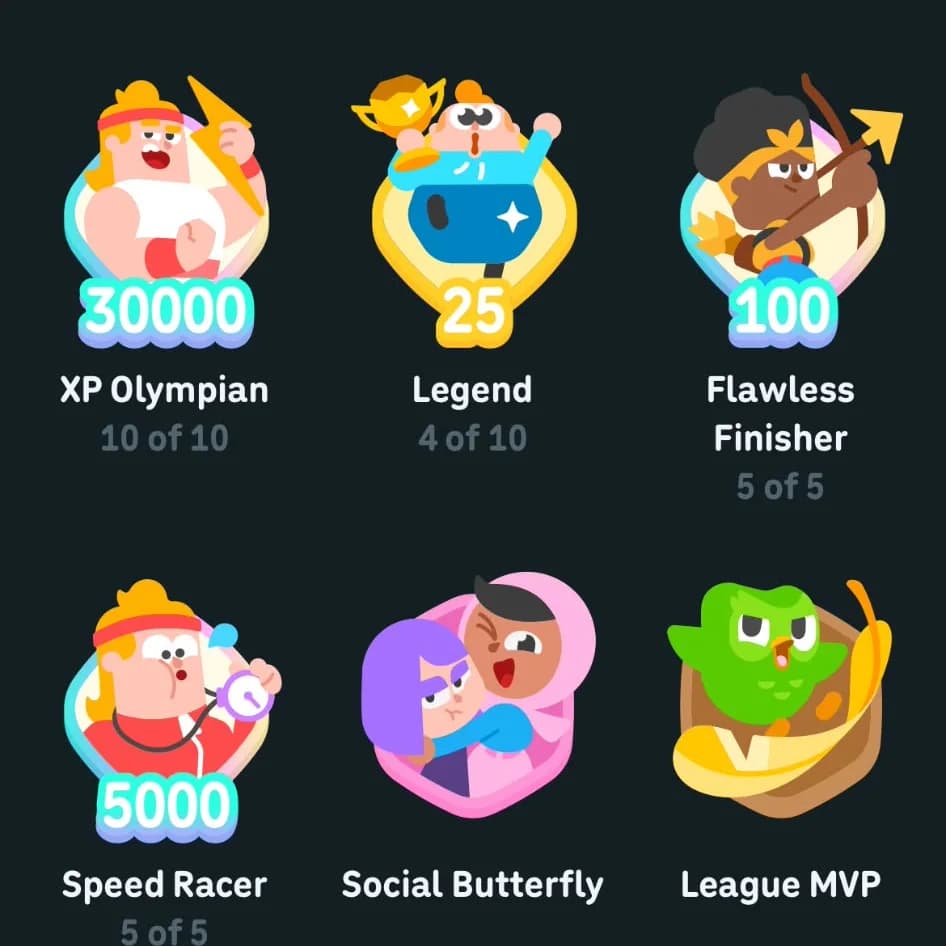




My Duolingo profile is covered in trophies. XP Olympian, top tier, for passing 30,000 XP. Flawless Finisher, maxed out. Speed Racer, maxed out. And a Duolingo Score of 19, which means I can introduce myself. So is Duolingo effective? Clearly, at something. The question I wanted answered is whether that something is Spanish.
Yes, for beginners, at reading, listening and vocabulary. Duolingo's own studies found learners who finished the beginner content reading at roughly a university fourth semester level. But almost every big study was run or paid for by Duolingo, tested only the people who finished, had no control group and skipped speaking. Independent research is small and mixed. Duolingo is an effective start. It is not, on its own, an effective way to become fluent.
In shortWhat the evidence adds up to5 points
- The famous "34 hours equals a semester" figure uses an average. At the typical learner's pace the same maths gives about 69 hours.
- In Duolingo's peer-reviewed study, Spanish learners read like fourth semester students but listened like beginners.
- Only people who finished were tested. That is the most motivated slice of users.
- The largest independent comparison found Duolingo better than a classroom on some measures and worse on listening.
- Gamification keeps people coming back. Whether it makes them learn more is a separate question nobody has answered well.
Is Duolingo effective? It depends what you measure
"Effective" hides three different questions. Does it get you to open the app? Overwhelmingly yes, nothing in language learning comes close. Does it teach you to understand written and slow spoken Spanish? Yes, at a beginner level, and there is decent evidence for it. Does it teach you to speak with a real person? That is where the evidence gets thin, and where my own experience says no, not on its own.
Keep those three apart and the whole debate gets easier. Most arguments online are one person talking about habit and the other talking about conversation.
Every major Duolingo study in one table
I went through the studies people quote, and the ones they do not. The key column is the second one: who ran it.
| Run or paid by | Learners | What was tested | What it found | |
|---|---|---|---|---|
| Vesselinov and Grego, 2012 | Commissioned by Duolingo | 88 | Spanish placement test, multiple choice | About 34 hours for a semester's gain, on average |
| Loewen and others, 2019 | Independent | 9 | Turkish, over one semester | Some gains, linked to time spent, mixed motivation |
| Jiang and others, 2021 | Duolingo staff plus one academic | 225 | Reading and listening | Reading near fourth semester students, Spanish listening lower |
| Duolingo speaking report, 2021 | Duolingo | 156 | Spanish speaking, automated test | 66 percent reached A2 or above |
| Duolingo blog, 2023 | Duolingo | 273 | Reading and listening | Halfway through B1 content compared to five semesters |
| Smith, Jiang and Peters, 2024 | Two of three authors at Duolingo | 48 | All four skills, three months | Gains on every measure, speaking and writing included |
| González-Fernández and de la Viña, 2025 | Independent, University of Sheffield | 337 | English, 16 weeks, vs a classroom | Duolingo ahead on general level and vocabulary, classroom ahead on listening |
The Sheffield study looked at Spanish speakers learning English, not English speakers learning Spanish.
The "34 hours equals one semester" claim
This is the number you have seen on a thousand blogs. It comes from a 2012 study Duolingo commissioned. Volunteers used the Spanish course for about two months and took a university placement test before and after. Of 156 people who started, 88 had results that were used, a drop-off of about 44 percent. There was no comparison group. Nobody was tested on speaking.
How 34 hours becomes 69 hours
The placement test puts you in second semester Spanish at 270 points. The average learner gained 8.1 points per hour, and 270 divided by 8.1 is about 33 hours. That is the headline. But a few very fast learners pull an average up. The median learner, the one in the middle, gained 3.9 points per hour. Same maths: about 69 hours. And no real semester was ever compared. It is a test score cut-off, not a class.
- At the average learner's pace33 h
- At the median learner's pace69 h
Worked out from the study's published gains per hour, as reported by Stephen Krashen (2014).
Duolingo's own peer-reviewed study
The strongest piece of evidence Duolingo has is a 2021 paper in Foreign Language Annals. 225 learners, 135 of them in Spanish, who had used only Duolingo and had just finished the beginner units, took official ACTFL reading and listening tests. Their reading came out at Intermediate Low, about where university students are after four semesters. Spanish listening came out around Novice High, and lower than the university students it was compared with. The Spanish learners took a median of 125 hours to get there.
What independent research says
Less than you would hope. An early Michigan State study followed 9 people learning Turkish for a semester: some gains, more time meant more gains, and plenty of frustration. The biggest independent test so far, from the University of Sheffield in 2025, compared 337 Spanish speakers learning English on Duolingo or in a classroom for 16 weeks. Duolingo learners did better on general level and on recognising words. Classroom learners did better on listening. I could not find a single independent study of English speakers learning Spanish at scale, and no review that pulls all the Duolingo research together into one verdict.
Where Duolingo works, and where it does not
Where the evidence and my hours agree
- Getting started from zero, with no plan and no teacher
- Building a daily habit you keep for months
- Vocabulary and reading at beginner level
- Grammar patterns, picked up by repetition
Where it falls short
- Listening at real speed, even in Duolingo's own data
- Speaking without a safety net
- Explaining why the grammar works
- Teaching much new after about 50 hours, in my experience
Learning the game, not the language
Duolingo's former product chief has said openly that the company leaned into game mechanics because games kept people coming back, and it worked: retention went up and more than half of daily users now hold a streak of a week or more. Those are measures of engagement. Nobody has measured well how much of that engagement turns into Spanish.
Look at my awards and you see someone who is excellent at Duolingo. Speed Racer, maxed. XP Olympian, maxed. League MVP. By July I had 36,944 XP.
Then look at the Score: 19. Early A1. The awards measure how well I play the game. The Score at least tries to measure Spanish. The distance between those two screens is the most honest answer I can give to this article's title.
The daily quests show the design clearly. Earn 10 XP. Finish two lessons. Score 80 percent three times. Each pays a chest of gems. None of them asks you to learn a new word or say anything out loud. They reward activity, because activity is what can be counted.
I wrote more about this trap, and how it feels from the inside, in my Duolingo streak guide.
How long would it take you?
One way to make the research useful: put your own habit next to the hours. Duolingo's Spanish learners needed a median of 125 hours to finish the beginner units. The US Foreign Service Institute puts professional Spanish at 600 to 750 classroom hours.
Calculator
How long would your Duolingo habit take?
Finish the beginner units (Duolingo study)
2.1 years
At 10 minutes, 7 days a week, you study about 61 hours a year.
- A2 by the FSI maths2.5 years
- B1 by the FSI maths4.9 years
- Professional Spanish, FSI9.9 years
- Finish the beginner units (Duolingo study)125 h
- A2 by the FSI maths150 h
- B1 by the FSI maths300 h
- Professional Spanish, FSI600 h
The first figure is the median time the Spanish learners in Duolingo's 2021 study took to finish the beginner units, and they were tested on reading and listening only. The FSI figures are classroom hours with a teacher. Treat all of it as a rough guide.
How to make Duolingo more effective
- Read every sentence out loud. It turns a tapping exercise into speaking practice, for free.
- Turn the leagues off if you notice yourself replaying easy lessons for points.
- Do Stories, not just lessons. They are the closest the app gets to real Spanish.
- Add real listening early, long before you feel ready. That is the gap in every study above.
- Test yourself outside the app every couple of months, so the game cannot fool you.
For the listening part, this is what I use. It is the opposite of Duolingo: no game, no slow audio, just Spanish shows with subtitles you can click.
I summarise published research here as a learner, not as a researcher, and some papers I could only read through summaries. Follow the sources if a detail matters to you. More in the disclaimer.
Sources
- Stephen Krashen (2014), "Does Duolingo trump university-level language learning?", on Vesselinov and Grego (2012): sample, gains per hour and criticism.
- Jiang, Rollinson, Plonsky, Gustafson and Pajak (2021), Foreign Language Annals 54(4), and the white paper version.
- Duolingo speaking report (2021)
- Duolingo blog, January 2023: the five semester comparison
- Smith, Jiang and Peters (2024), Language Learning and Technology 28(1)
- Loewen and others (2019), "Mobile-assisted language learning: a Duolingo case study", ReCALL 31(3)
- González-Fernández and de la Viña (2025), Language Learning and Technology 29(1), University of Sheffield
- Jorge Mazal, former Duolingo product chief, on gamification and retention (2023)
- US Foreign Service Institute: class hours by language
- Awards, quests, XP and Score are from my own Duolingo account, screenshots taken October 17, 2026, and July 2026 for the XP total.