



36,944 XP. A Spanish Score of 19. A cartoon woman in a pink headscarf telling me I can now introduce myself. And me, still pointing helplessly at the menu every time I tried to order a coffee and hoping the barista would take pity on me. That gap between what the app says and what happens in real life is what this whole article is about.
Yes, you can learn Spanish with Duolingo, as a foundation. It is a great way to get from zero to the basics and to build a daily habit. No, Duolingo alone will not make you fluent. Somewhere around the end of the beginner sections you need real Spanish at real speed (I use Lingopie for that) and some conversation with humans.
In shortIf you only have a minute5 points
- Duolingo's Spanish course now runs to the end of B2 on its own scale (a Duolingo Score of 129). That is Duolingo's claim about its content, not a certificate.
- Its published research tested reading and listening. Not speaking, not writing.
- By the US Foreign Service Institute's numbers, B1 takes roughly 300 to 375 hours of study. Fifteen minutes a day gets you there in about 40 to 49 months.
- For me the app flattened out after about 50 hours. That is when to add real listening.
- You do not need Super or Max to learn Spanish on Duolingo. The free version has every lesson.
I already wrote my full Duolingo review, where I gave it 4 out of 5 and called it the best front door into Spanish there is. This piece answers a different question, the one I kept typing into Google myself: is Duolingo enough to learn Spanish, or is it a very charming way to feel busy?
Can you learn Spanish with Duolingo? Yes, up to a point
Let me start with the good news, because there is plenty of it. Duolingo teaches you real Spanish words and real grammar, and it does it in a way that a tired person can stick with on a Tuesday night. Nobody else has cracked that part as well. If you are starting from nothing, the app removes the hardest decision of all, which is what to do today.
What the Spanish course covers in 2026
The course from English has 8 sections, from an intro through two at B2, and since April 2026 almost everyone can study all the way to the end of B2. A fan-run tracker counts 991 units, and only 131 of them are beginner material. The section by section map, with score ranges and what each part teaches, is in my Duolingo Spanish course guide.
So on paper, the course goes a long way. In practice, the beginner sections are where most of us live for a long time. I am in Section 2, Unit 25, fighting pronouns, after months of daily lessons.
This is my path, the same screen I open most days. It is tidy and friendly and it never asks too much of you at once, which is the whole trick. You tap through a matching exercise, type a sentence you heard, read a short story, and the little icons move you along.
What you do not see from here is how far the road goes. Section 2 feels like progress, and it is. It is also still A1 territory, the very bottom of the ladder.
What a Duolingo Score of 19 means
The Duolingo Score runs from 0 to 160, and the Spanish course ends at 129. My 19 is early A1, about 15 percent of the way through. It tracks progress through the course, not what you can do in a conversation. The full chart, and what each band means in real life, is in Duolingo Score explained. For a level check that does not come from the app itself, try my A1 Spanish quiz.
What Duolingo's own research says, in one paragraph
Duolingo's peer-reviewed study (Foreign Language Annals, 2021) found that 225 adult beginners who used only Duolingo read about as well as university students after 4 semesters, and a later Duolingo report on 273 Spanish learners claimed 5 semesters for people halfway through B1. Both tested reading and listening only, both were run mostly by Duolingo staff, and only learners who finished were tested. I went through every study, including the independent ones, in is Duolingo effective?
Is Duolingo enough to learn Spanish on its own?
For the basics, close to yes. For the Spanish you came for, the one you want to use on a trip or with a partner's family, no. I see three gaps, and they get wider the further you go.
Real speed listening is the big one
Duolingo's audio is slow and clean on purpose. Then you watch a travel vlog where two locals chat at full speed, swallowing half their consonants, and the floor drops away. The first time I tried to follow a conversation between native speakers who were not slowing down for me, I understood maybe a third of it. Inside the app I felt confident. Outside it, I felt like I had been studying a different language. If you got into Spanish through travel videos like I did with Kurt Caz, you will know the feeling.
Speaking without a safety net
Tapping word tiles is recognition. Saying a sentence out loud to a stranger who is waiting for you is production, and the two live in different parts of your brain. The free app gives you some speaking exercises, and the AI video calls sit behind a paywall. None of it replaces the moment a real person looks at you and waits.
Grammar you have to look up somewhere else
The grammar tips are short and easy to skip when you are rushing to keep a streak. You pick up patterns by exposure, which works, slowly. When ser and estar refuse to make sense, you end up on a forum or a YouTube video anyway.
Can you become fluent with Duolingo?
Not with Duolingo alone, no. I would love a different answer, because it would make life easy. Most people mean B2 or higher when they say fluent: you can follow a film, argue about football, tell a story with all its tenses and not panic when someone replies. Duolingo's content now reaches the end of B2 on paper. Being able to do B2 things in a real conversation is another matter, and the app does not test for it.
Duolingo's own mapping. Finishing the content is not the same as being able to use it out loud, and the course does not cover C1 or C2.
Four Duolingo myths I fell for, at least a little
Finish the Spanish course and you are fluent.
The course ends at B2 by Duolingo's own mapping, and its published research covers reading and listening. Fluency is a speaking and listening skill first.
A long streak means your Spanish is getting better.
A streak measures showing up. My profile has a 0 day streak next to 36,944 XP, and the XP tells the truer story. I switched the streak pressure off when I noticed I opened the app out of guilt.
Your Duolingo Score is an official Spanish level.
It tracks your progress through Duolingo's content. My score said I could introduce myself. My mouth disagreed at the coffee counter.
Duolingo has proved it equals four semesters of college Spanish.
In reading and listening tests, for 225 learners who finished the beginner units, run mostly by Duolingo's own researchers. Useful, and narrower than the headline.
How long does it take to learn Spanish on Duolingo?
Duolingo does not promise a number of months, and nobody honest can. What we do have is the US Foreign Service Institute estimate: Spanish is one of the easiest languages for English speakers, at about 600 to 750 class hours to reach professional working proficiency. Those are full-time classroom hours with a teacher and homework, so app hours usually stretch further, not less.
The hours each level takes
Split that into levels and you get roughly 150 to 188 hours for A2, 300 to 375 for B1 and 450 to 563 for B2. Put my 50 hour mark next to those and you can see why the app starts to feel thin when it does. You are not close to the end. You are at the start of the long middle.
- Where Duolingo flattened for me50 h
- A2: everyday basics150 to 188 h
- B1: get by on a trip300 to 375 h
- B2: real conversations450 to 563 h
- Professional (FSI goal)600 to 750 h
Bars show the low end of each range. Level hours are shares of the FSI estimate, a rough guide rather than an exact count.
Play with your own pace below. Try your real daily Duolingo time first, then see what happens when you add half an hour of a show in the evening.
Calculator
How long until you reach your Spanish goal?
A2: everyday basics
Time to reach A2, roughly
20 months to 2.1 years
- Study time a week
- 1.8 hours
- Hours needed for A2
- 150 to 188
- Hours a month
- 8
An estimate, not a promise. Speaking with real people speeds this up more than any app streak.
- A2: everyday basics20 months
- B1: get by on a trip3.3 years
- B2: real conversations4.9 years
Based on the US Foreign Service Institute's estimate that Spanish takes about 600 to 750 class hours to reach professional working proficiency (FSI). The lower levels are rough shares of that. FSI hours are classroom hours with a teacher, so treat the low end as a best case.
A realistic Duolingo year, month by month
Here is what the maths looks like at 15 minutes a day, every day, which is about 7.6 hours a month. This is an illustration built from those numbers and my own experience, not a measured study of Duolingo users.
Month 1, about 8 hours
The habit forms
Greetings, numbers, soy and tengo. The first score milestones come quickly and feel great. Enjoy this part, it is what Duolingo does best.
Month 3, about 23 hours
The first reality check
You read simple sentences without thinking. Then a real video in Spanish loses you within a minute. This is a good time to add a little listening, even a few minutes a day.
Month 7, about 50 hours
Where it flattened for me
Lessons start to repeat patterns you already know. This is my cut-off: Duolingo drops to 10 minutes a day and the main study time moves to real Spanish.
Month 12, about 91 hours
A year in, still A1 to A2
A full year of 15 minutes is still well short of the A2 estimate. Time with shows and people is what speeds this up.
Months 20 to 25
A2 by the FSI maths (150 to 188 hours)
Everyday basics. Shopping, directions, small talk about the weather. A real milestone, and the gate to the fun part.
Signs you have outgrown Duolingo
Outgrowing the app does not mean deleting it. It means it should stop being your main source of Spanish. Tick off what sounds like you.
Have you outgrown the owl?
0 of 6
Should you keep going with Duolingo alone?
Are you still in the first 3 sections (the intro and A1)?
What to add next: real Spanish with Lingopie
Here is what worked for me once the app ran out of road. I did not swap Duolingo for a different course with the same slow audio. I switched to Spanish that was never made for learners: series. Lingopie puts Spanish shows from Spain and Latin America next to clickable subtitles, so you can tap a word, see what it means and save it as a flashcard with the scene still attached. My card for entrar comes with the Professor from La Casa de Papel, at the moment he says they will enter the Banco de España.
I rated it 4.5 out of 5 in my Lingopie review, and it came first in my test of ten apps. About three weeks in I could understand simple conversations, and after two months I could follow a series without pausing every five seconds. It is not for total beginners, though. My advice: learn your first 500 to 1,000 words on Duolingo, then move over. If shows are not your thing, my ranking of the best apps to learn Spanish covers the other routes, from audio lessons to tutors.
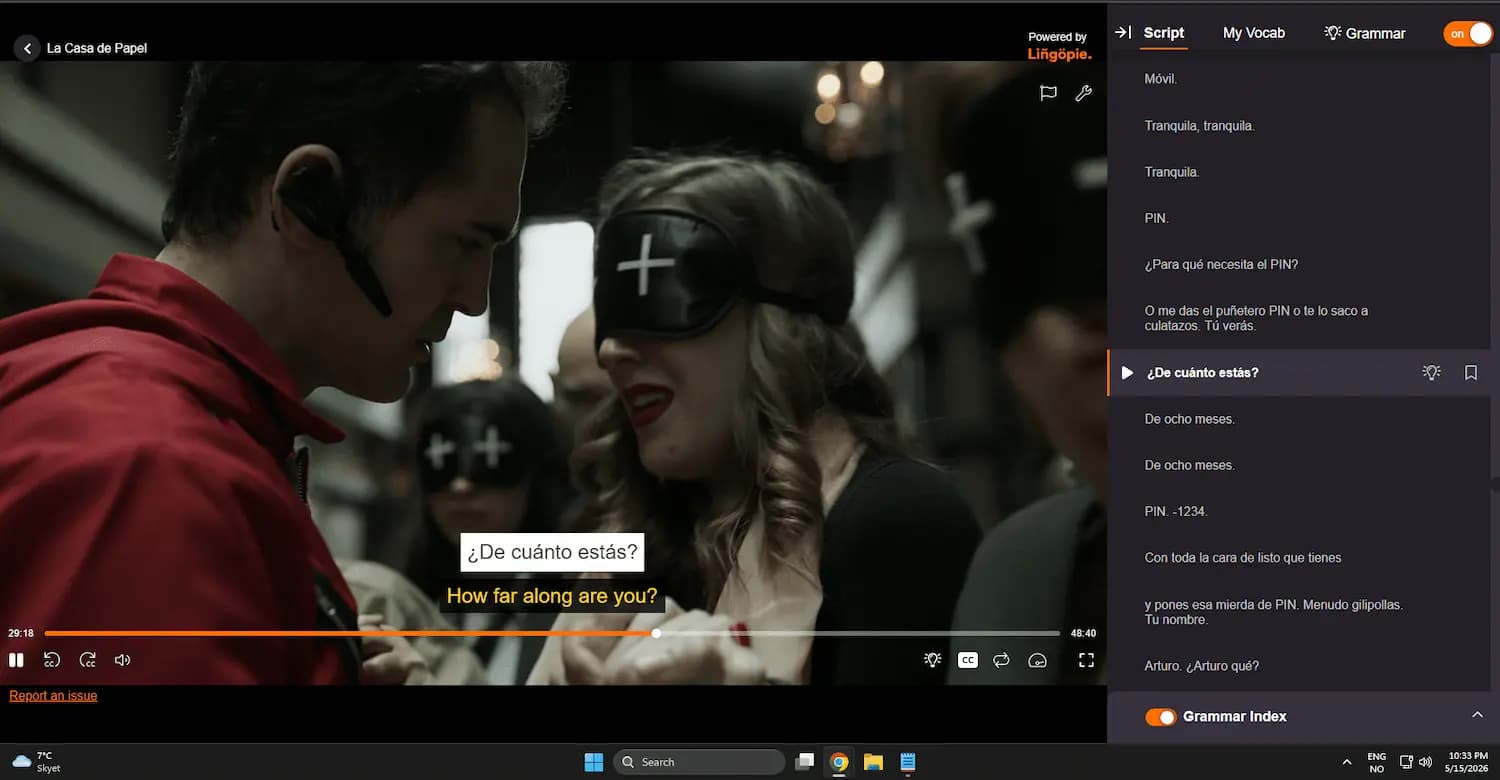
Duolingo vs Lingopie, side by side
| Criterion | DuolingoFree, with adsWins 3 of 7 | LingopieFrom $6.99/mo, yearlyWins 3 of 7 |
|---|---|---|
| Starting from zero | Winner: Built for it | Too fast for day one |
| Building a daily habit | Winner: The best there is | Easy if you watch TV anyway |
| Real-speed listening | Slow, clean audio | Winner: Native speed shows |
| Accents and slang | Ustedes only, no vosotros | Winner: Spain and Latin America |
| Words with context | Single sentences | Winner: Flashcards tied to scenes |
| Price | Winner: Free version is complete | $83.88 a year on sale |
| Best level | Beginner to A2 | A2 to B2 |
Lingopie price at the time of writing, from its pricing page. Sale prices come and go. The full head to head is in Duolingo vs Lingopie.
One practical note from my own trial: it asks for a card up front, so set a reminder for day six if you are not sure yet.
And talk to people, even badly
Listening gets you understanding. Speaking only comes from speaking. A tutor, a language exchange, a live group class or a chatty neighbour from Valencia all count. I booked Lingopie's live group lessons on Zoom and loved how small the classes were, though they are now sold as a separate plan, so check the current terms in your account. The Spanish portal collects everything else on this site that helps with that step.
Do you need Super or Max to learn Spanish on Duolingo?
No. Every lesson is in the free version. What you pay for is comfort: no ads, unlimited energy and, depending on the tier and where you live, AI conversation features. I said it in my Duolingo review for Spanish and I still mean it: keep the free version. For roughly the price of a year of Super, which starts at $83.99, you could have a year of Lingopie on its current sale ($83.88), which teaches you something the owl cannot. Plan by plan prices, and what each one adds, are in the pricing section of my review.
The first row on this screen gives the game away. Learning content: a tick for Free, a tick for Super. Everything under it is about energy, ads and extras. Nice to have. Not more Spanish.
One person's experience, plus public numbers. Learning speed varies a lot from person to person, so read the estimates here as a rough guide, not a promise. More in the disclaimer.
Sources
- Duolingo blog, "Duolingo Score": score ranges and CEFR levels
- Duolingo blog, April 22, 2026: Spanish and eight other courses now teach through B2 (score 129)
- Duolingo Data (fan-run tracker), Spanish from English, sections and unit counts, September 2026
- Jiang, Rollinson, Plonsky, Gustafson and Pajak (2021), "Evaluating the reading and listening outcomes of beginning-level Duolingo courses", Foreign Language Annals 54(4)
- Duolingo blog, January 2023: Spanish learners and the five semester comparison
- Charlie Taylor, "A Review of Duolingo's In-House Research Reports", CALL-EJ 23(3)
- Duolingo blog, May 2026: why the Spanish course teaches ustedes and not vosotros
- US Department of State, Foreign Service Institute: language learning difficulty and class hours
- Duolingo on the US App Store: Super Duolingo in-app prices, plus third-party price trackers for Max, checked October 2026.
- Lingopie pricing page, checked October 14, 2026.
- Screenshots, score, streak and XP figures are from my own Duolingo account, taken July 2026. The Lingopie screenshots are from my own account.