



Section 2, Unit 27: "Talk about music preferences". That is where I am today. It feels like a long way in, because the path behind me is a column of green circles that takes ages to scroll. Then I opened the course overview and counted what is ahead. I am about 4 percent of the way through the units. This is the map I wish I had looked at on day one.
Duolingo's Spanish course for English speakers has 8 sections: an intro, two at A1, one at A2, two at B1 and two at B2. It ends at a Duolingo Score of 129, the top of B2. A fan-run tracker counts about 991 units in total, and only 131 of them are beginner material. It teaches Latin American leaning Spanish with ustedes, not vosotros.
In shortThe course on one card5 points
- 8 sections, intro to the end of B2, a Duolingo Score from 5 to 129.
- About 991 units. The first four sections hold only 13 percent of them.
- Since April 2026 almost everyone can study all the way to B2. Before, most learners stopped at the end of A2.
- You can test out of sections with "Jump here", but a placement cannot be undone.
- It teaches ustedes only. If you are going to Spain, learn vosotros elsewhere.
How the Duolingo Spanish course is built
Duolingo stacks the course in three layers. Sections are the big chapters, each tied to a level and a range on the Duolingo Score. Each section holds units, and each unit is a theme like ordering food or, in my case right now, saying which music you like. Units are made of lessons, stories, listening exercises and the odd treasure chest.
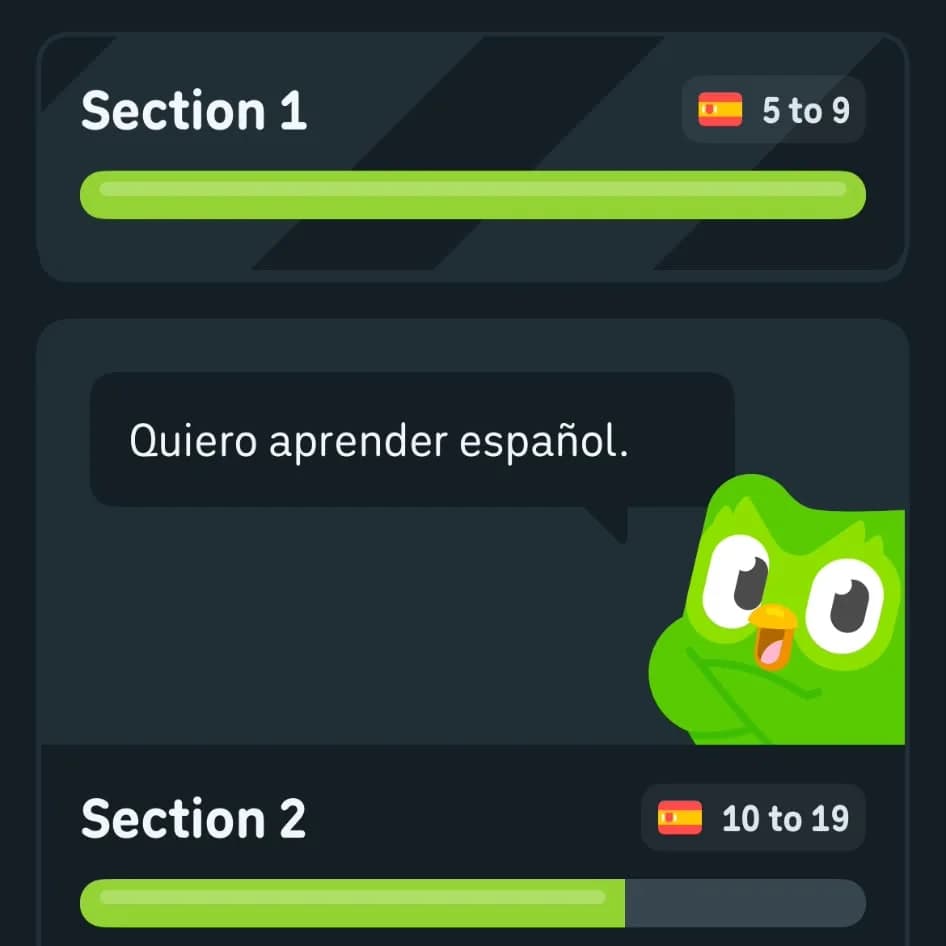
This screen is easy to miss. Tap the green section banner at the top of the home screen and you get the whole course as a list. Each section shows its score range and how much of it you have done. Section 1 is full. Section 2 is about two thirds there.
Section 3 has a "Jump here" link under it. More on that below, because it is the most useful button in the app if you already know some Spanish.
All 8 sections, from "hola" to B2
Here is the full ladder. The score ranges for Sections 1 to 3 are the ones my app shows. For the later sections I used Duolingo's own Score to CEFR table, which the first three match exactly.
Section 1, Intro, score 5 to 9
Essential phrases, about 10 units
Greetings, numbers, a few verbs. The quickest section by far.
Section 2, A1, score 10 to 19
Basic interactions, about 31 units
This is me. Unit 27 is "Talk about music preferences", which mostly means wrestling with me gusta and me gustan.
Section 3, A1, score 20 to 29
Foundational conversations, about 30 units
Section 4, A2, score 30 to 59
Everyday topics, about 60 units
The last beginner section. Finish this and you have reached what used to be the end of the course for most people.
Section 5, B1, score 60 to 79
A wider variety of topics, about 250 units
Section 6, B1, score 80 to 99
More complex ideas, about 250 units
Section 7, B2, score 100 to 114
Abstract feelings and opinions, about 180 units
Section 8, B2, score 115 to 129
Confident conversation, specialised topics, about 180 units
The finish line, at a score of 129. The milestone on the Score screen simply says "Course complete".
Where the units are: the course is all middle
This is the part that surprised me. The beginner sections are short. The intermediate ones are enormous. Sections 5 and 6 alone hold 500 units between them.
From duolingodata.com, a fan-run tracker that reads the course data. Duolingo itself does not publish unit counts, and the numbers move whenever the course is rebuilt.
Section 2 feels like progress, and it is. It is also the shallow end of a very deep pool.
What you learn at each level
The section names in the app are vague, so here is what each stage is for, based on Duolingo's CEFR descriptions and my own time in the early sections. Pick the one you are in.
Sections 1 to 3. Introduce yourself, talk about family, food, your day and what you like. Present tense, the big verbs (ser, estar, tener, ir), and gustar, which will humble you. By the end you can order at a restaurant if the waiter is patient.
Section 4. Shopping, weather, hobbies, past events. The past tenses arrive and the sentences get longer. This is where Duolingo used to end for most learners.
Sections 5 and 6, the biggest part of the course. Travel situations, directions, reservations, telling stories and giving opinions. More reading and listening, more subjunctive, more real-world topics.
Sections 7 and 8. Feelings, opinions, abstract and specialised topics, the kind of Spanish you need for news, films and work. Duolingo calls the top of it professional and academic use. Finishing it is a big achievement, but it is not a B2 certificate.
B2 for everyone since April 2026
Until this spring, most learners could only see the course up to the end of A2, a score of 59. In April 2026 Duolingo said Spanish and eight other large courses now teach everyone through B2, up to 129. The Spanish course was also rebuilt during 2026, and some learners complained that their progress moved around or that they suddenly met material they had never seen. If your path looks different from a friend's, that is probably why.
A typical Section 2 unit, from my path
This is what a unit looks like from the inside. Stars are lessons, the dumbbell is practice, the headphones are a listening exercise and the chest pays out gems. Notice the line in the middle: "Course update: Learn new words". Duolingo slotted fresh vocabulary into my path without asking, which is how the rebuilds show up for learners.
Score 19, gems at the top, and a streak counter at zero that I will explain in my streak guide.
Want to feel what Section 2 is like? These are the kind of sentences my current unit drills. Four questions, and the explanations tell you why.
A taste of Section 2: music preferences
1 / 4
How do you say: I like rock music?
The placement test and "Jump here": should you skip ahead?
When you start the course Duolingo asks whether you want to start from scratch or find your level. The placement test adapts to your answers and unlocks what you already know. You can still go back and review the earlier lessons, but the placement itself cannot be undone.
Later on, every section further down the course has a "Jump here" link, like the one under Section 3 on my screen. Pass a short test and you skip to the start of that section. Fail it and nothing happens, you just carry on where you were.
Which Spanish does Duolingo teach?
Is it Mexican Spanish? Not officially. Duolingo does not call it that, but with ustedes and mostly Latin American words, it will feel much closer to Mexico City than to Madrid.
What else is inside the Spanish course
The path is the main road, but the Spanish course has the most side streets of any Duolingo course, because it is the biggest. The fan tracker counts about 8,346 lessons and 1,128 stories.
Stories
Short illustrated dialogues with questions. The best part of the free app, in my opinion.
DuoRadio
Podcast style listening lessons with Duolingo's characters. Still slow, but longer.
Practice Hub
Review old material. The personalised mistakes practice is a Super feature.
Video Call
AI conversations with Lily. Paid, now part of Super for most new subscribers.
Explain My Answer
Tells you why your answer was wrong. Free for most Spanish learners since 2026.
Adventures
Little game scenes where you walk around and talk to characters.
What it costs to unlock the paid ones, and whether any of it is worth it, is in is Duolingo free?
How long does the whole course take?
Duolingo does not say, and with about 991 units nobody can tell you in months without guessing at your pace. From my own time in the app, the beginner sections take months of daily lessons, and the intermediate part is several times longer. For hour estimates by level, and whether the app alone can get you there, read can you learn Spanish with Duolingo?
Unit counts come from a fan-run tracker and change when Duolingo rebuilds the course. Your path may look different while Duolingo tests new versions. More in the disclaimer.
Sources
- Duolingo blog, April 22, 2026: Spanish and eight other courses now teach through B2, a score of 129
- Duolingo blog, "Duolingo Score": the score ranges for each CEFR level
- Duolingo Data (fan-run tracker), Spanish from English: sections, unit, lesson and story counts
- Duolingo blog, "Duolingo 101": placement, the path, Stories and the Practice Hub
- Duolingo blog: why the Spanish course teaches ustedes and not vosotros
- Android Authority, July 2026: learner complaints about the course rebuilds
- Section ranges, unit names and the path screens are from my own Duolingo account, screenshots taken October 17, 2026.