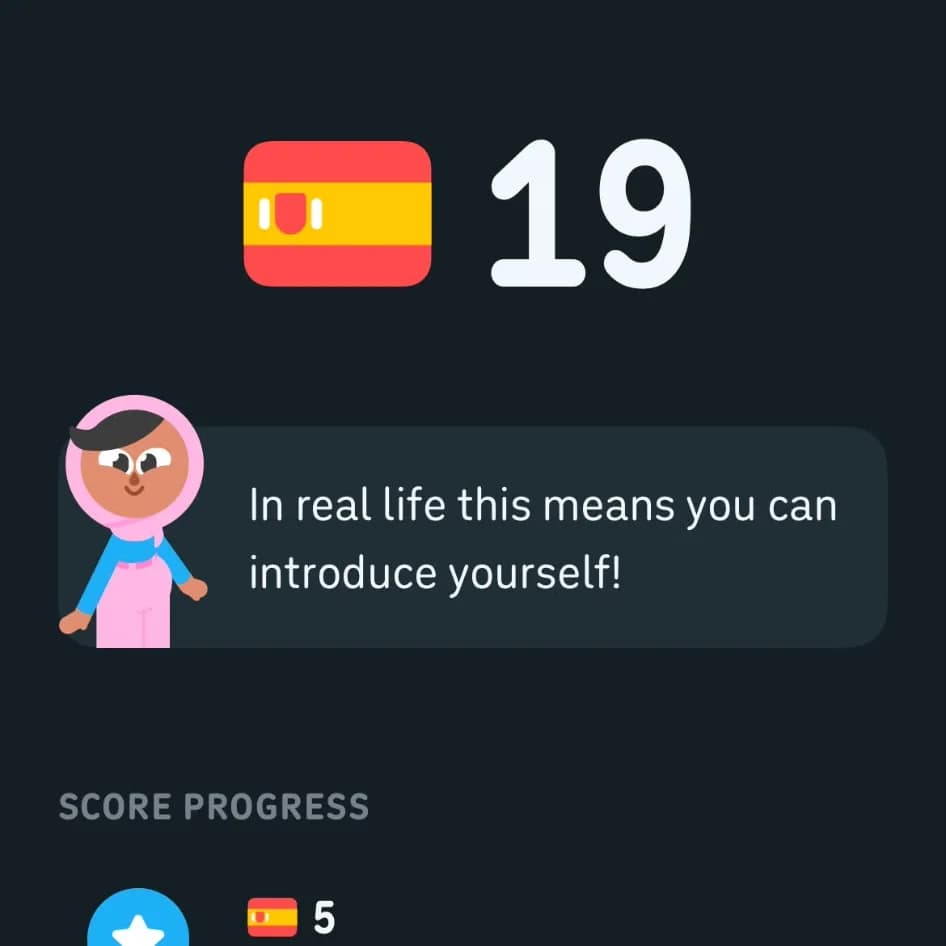




In July my Duolingo Score was 19. Three months and two units later, it is still 19. The little cartoon on the Score screen keeps telling me the same thing: in real life, I can introduce myself. Which is true. I can. I just could not order a coffee in Spanish without pointing at the menu, and that gap is the whole story of this number.
The Duolingo Score is a number from 0 to 160 that shows how far you have come through a Duolingo course. Duolingo maps it onto the CEFR levels: 10 to 19 is early A1, 30 to 59 is A2, 60 to 99 is B1, 100 to 129 is B2. It goes up as you finish lessons. It is a progress marker, not a test or a certificate.
In shortThe number in sixty seconds5 points
- The scale runs from 0 to 160, the same range as the Duolingo English Test, but it is a different thing.
- The Spanish course ends at 129, the top of B2. Everything from 130 up is C1 and C2, which no course teaches yet.
- It rises when you finish lessons and move along the path. Duolingo publishes no formula.
- You can show it on LinkedIn, where it updates by itself.
- My 19 is early A1, about 15 percent of the way through the Spanish course.
What is the Duolingo Score?
Duolingo introduced the Score in October 2024, first for Spanish, French and English, and in 2025 it spread to every language course. It sits right next to the flag at the top of your home screen, so you see it every time you open the app. Tap it and you get a screen with your number, one sentence about what it means in real life, and a ladder of milestones.
Before the Score existed, Duolingo progress was XP, crowns and how far down the path you had scrolled. None of those told you anything about your Spanish. XP measures effort. The Score at least tries to measure where you stand, and pinning it to the CEFR scale means you can compare it with a class, a textbook or a job ad that asks for B1.
Duolingo Score to CEFR: the full chart
This is Duolingo's own table, with the plain English description it gives for each band. I added the milestones from my own Score screen in the app, because they do not always match the blog word for word.
| Score | CEFR level | Duolingo says you can | App milestone |
|---|---|---|---|
| 0 to 9 | Very early A1 | Use simple words and phrases | 5: Getting started |
| 10 to 19 | Early A1 | Talk about yourself and ask and answer simple questions | 10: Introduce yourself |
| 20 to 29 | High A1 | Talk about your daily routine and order food at a restaurant | None |
| 30 to 59 | A2 | Hold basic conversations about the weather, shopping and hobbies | 30: Order food at a restaurant, 50: Give directions to a place |
| 60 to 79 | Early B1 | Handle travel situations, ask for directions and make reservations | 70: Read a short story |
| 80 to 99 | High B1 | Share opinions and tell stories | 90: Watch a TV show |
| 100 to 114 | Early B2 | Understand the news, films and jokes | 110: Communicate at work |
| 115 to 129 | High B2 | Use the language in professional and academic settings | 129: Course complete |
| 130 to 160 | C1 and C2 | Use nuanced, sophisticated language | None |
One small mismatch: the blog puts ordering at a restaurant in the 20s, while my app saves that milestone for 30. Treat the bands as rough neighbourhoods, not fences.
Why the Spanish course stops at 129 when the scale goes to 160
Because the courses stop at the end of B2. In April 2026 Duolingo said Spanish and eight other big courses now teach all the way to a score of 129, where most learners used to top out at the end of A2. The band from 130 to 160 is reserved for C1 and C2, and no course goes there yet. So if you finish Spanish, the last milestone says "Course complete" and the number simply stops.
Convert your own Duolingo Score
Slide to the number on your flag. You get the level, what Duolingo says it means, the next milestone the app will show you, and how far through the Spanish course you are.
Calculator
What does your Duolingo Score mean?
Find the number next to the flag at the top of your Duolingo home screen and slide to it. The level comes from Duolingo's own table, the milestones from the Score screen in the app.
A score of 19 is
Early A1
Duolingo says you can talk about yourself and ask and answer simple questions.
- Milestone reached10, introduce yourself
- Next milestone30, order food at a restaurant (11 to go)
- Through the Spanish courseAbout 15 percent
The Spanish course ends at 129. Scores from 130 to 160 are C1 and C2 on Duolingo's scale, which no course teaches yet. A score is Duolingo's measure of how far you are through its content, not an exam result.
What a Duolingo Score of 19 means in real life
On paper, 19 is early a1: you can talk about yourself and ask and answer simple questions. My next milestone is 30, "order food at a restaurant", which is 11 points away. That sounds close. It is not, because the jump from 19 to 30 crosses the line from early A1 into the top of A1, and that is a lot of lessons.
This is the screen behind the number. The blue line has passed 5 and 10, and the next stop is a fork and knife at 30. I like how concrete these milestones are. Ordering food, giving directions, reading a short story. Those are things you can test on a holiday.
What the screen cannot know is how it goes when the waiter talks back. Introducing myself, I can do. Following a reply at full speed is a different skill, and the Score does not measure it.
The same score for three months
Between July and October I moved from Unit 25 to Unit 27 of Section 2, and the number did not move. In my app Section 2 is labelled with the range 10 to 19, and I am already at the top of it. My guess, and it is only a guess, is that the next point comes when I cross into the Section 3 range. If your score has been stuck for weeks, check where you are on the path before you assume something is broken.
The course overview shows the link between sections and the Score plainly. Section 1 covers 5 to 9, Section 2 covers 10 to 19, Section 3 covers 20 to 29. Those line up with Duolingo's CEFR bands, which makes me think the later sections follow the same chart.
The full map of all eight sections, with what each one teaches, is in my Duolingo Spanish course guide.
How the Duolingo Score goes up, and whether it can go down
Duolingo says the Score rises "as you complete more lessons and advance through the units". That is all it says. There is no published formula, no points per lesson, no bonus for perfect lessons. In practice that means three things.
- New lessons move it, replays do not seem to. Grinding old lessons for XP is great for your league position and does nothing visible to the Score.
- It moves in steps. You can work for weeks inside one band and see the same number, as I did.
- Jumping ahead counts. Pass a "Jump here" test and you land in a later section, and the Score should follow you there.
Can it go down? I could not find an official answer. When Duolingo rebuilt courses, a staff member wrote on the learner forum that your place on the path and your Score would "remain the same, or very nearly so". So the honest summary is: it is not meant to drop, but a course rebuild can nudge it.
Duolingo Score vs the Duolingo English Test
People mix these up all the time, because both use a scale that tops out at 160 and both carry the Duolingo name. They are different products for different jobs.
| Criterion | Duolingo ScoreInside the appWins 0 of 6 | Duolingo English TestSeparate examWins 2 of 6 |
|---|---|---|
| Languages | Every language course | English only |
| Cost | Free | Paid exam |
| Supervised | No | Winner: Yes, proctored online |
| Scale | 0 to 160 | 10 to 160, in steps of 5 |
| What it shows | Your progress through a course | Your English, for universities |
| Accepted as proof of level | No | Winner: By many universities |
If a university asks for a Duolingo score, it means the English Test, not the number on your flag.
How to add your Duolingo Score to LinkedIn
Since September 2025 you can show the Score on your LinkedIn profile. You link your Duolingo and LinkedIn accounts, and the Score appears in the Languages section of your profile and updates on its own as you progress. Look for the LinkedIn option in the app's settings or on the Score screen, since the exact route moves around between app versions.
Is the Duolingo Score accurate?
It is accurate about what it measures, which is your progress through Duolingo's content. Whether that content turns into usable Spanish is a separate question, and the research behind it mostly tested reading and listening. I went through those studies in is Duolingo effective?, including who ran them.
Why a progress score and a level are not the same thing
A CEFR level describes what you can do with a language: speak, write, listen, read, under real conditions. The Score describes how much of a course you have finished. Two people with the same Score can be miles apart. One read every story aloud and chatted with a neighbour. The other tapped tiles on the bus. Both get the same number.
The levels come from Duolingo's own mapping and my screenshots come from one account. Your app may show slightly different milestones while Duolingo tests new versions. More in the disclaimer.
Sources
- Duolingo blog, "Duolingo Score" (October 23, 2024): the 0 to 160 scale and the CEFR table
- Duolingo blog, April 22, 2026: Spanish and eight other courses now teach through B2, a score of 129
- Duolingo blog, 2025 product highlights: the Score launched for all language courses
- Social Media Today, September 2025: Duolingo Score on LinkedIn profiles
- Duolingo English Test, scoring guide for teachers (2026): the 10 to 160 scale
- A Duolingo staff member on the learner forum (2025) on scores staying "the same, or very nearly so" after a course rebuild. Forum post, not an official policy page.
- Score, milestones, section ranges and unit numbers are from my own Duolingo account, screenshots taken October 17, 2026, and July 2026 for the earlier score of 19.