



Who Is Peter Santenello?
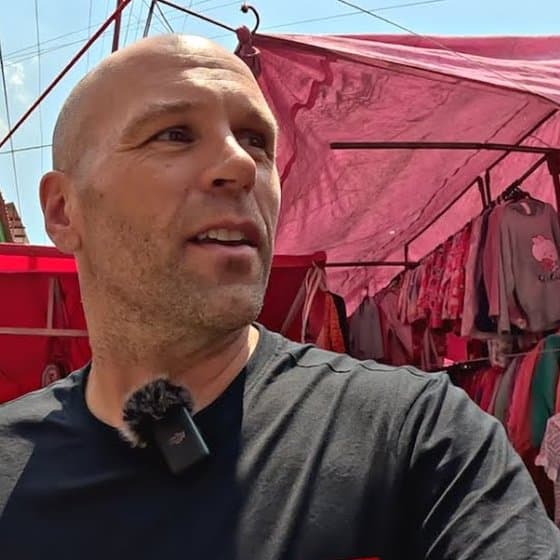
Peter Santenello is an American YouTuber from Vermont who films the parts of the United States most Americans only know from the news: Amish farms, coal towns in Appalachia, Hasidic New York, the Mexican border, an Alaskan town where everyone lives in one building. He works alone with a GoPro on a stick. There's no narrator and no sad piano telling you how to feel. His wife Natalia edits every video at home, and in 2026 his first book, Your Fellow Americans, became a New York Times bestseller.
His whole method fits in three words, and he says them in almost every video: “I know nothing.” He walks into a holler or a cartel corridor, admits he's a rookie, and asks people what they do, what they earn and what outsiders get wrong about them. Then he says “Okay.” Then he asks if that's fair to say. It shouldn't work. It's like opening a job interview with “So what is it you people do here?” and walking out as CEO.
The rookie act is earned. Before YouTube he flopped with a TV pitch, a tech startup and a good share of everything else he tried, and he didn't find his thing until he was 40, in a Ukrainian village, digging a well with a family who had lost everything. Most men hit 40 and buy a motorcycle. Peter hit 40 and moved in with strangers to haul dirt out of a hole. When I hit 40 I bought a standing desk, and I've stood at it twice.
Where Is Peter Santenello From?
Vermont. He was born in Burlington in 1977, grew up in the countryside just south of it in Panton, and finished high school in Vergennes in 1995. He calls Vermont “the most homogeneous white place on the planet”, which is a strange start for a man who would spend his career filming everybody else.
He's only there because of a broken subway. His father's family is from Hoboken, New Jersey. As Peter tells it, his dad got stuck on a train under the Hudson for three hours in the dark, snapped and moved north “to Vermont with $200 so the legend says, and bet $100 on the Super Bowl, which he lost.” Half his savings, gone on one football game in his first week in a new state. That's not a fresh start. That's a fresh start with a gambling problem.
The family never travelled. His dad got two weeks of holiday a year and hated his job, and he kept the kids working so hard that Peter says “I was like on a freaking prison camp with the work I had to do.” He gives that prison camp the credit for the fact that he has posted a video almost every week for years. When he was about ten, a neighbour told him to tap the sugar maples for syrup. He tapped the pines and the oaks. A Vermont kid who can't find a maple tree is like a Texan who can't find a steak, and they should have taken his citizenship away right there. I once spent twenty minutes looking for my glasses while wearing them, so I'm not throwing stones.
He grew up on a family legend that his grandfather's gas station in Hoboken was where Frank Sinatra filled up, and that the family were his best buddies. When Peter finally went to Hoboken to film with his cousin Anthony, a retired police captain, he asked about it. Anthony's verdict was one word: “Folklore.” Sinatra had left Hoboken before the station opened. Peter then asked if the family had been in the mob. “No.” “Nothing?” “No.” He sounded let down. Every Italian-American family has a Sinatra story. It's like the sauce recipe: everyone swears theirs is the real one, and nobody can prove it.
The Italian side left him one useful thing, a second passport through his great-grandparents, who came over from near Naples in 1918. He doesn't speak Italian and says “I don't claim Italian at all”, but that passport comes back later in this story. His father died years ago. His mother still lives in Vermont, and when Peter moved to Florida she asked him if he was retiring.
What Did Peter Santenello Do Before YouTube?
A bit of everything, and most of it went sideways. He was, in his words, “a terrible student”, so his parents moved him to a small, chaotic hippie school where the students argued both sides of hot-button issues and then switched. He says it's probably why he does what he does today. After graduation he bought a van and drove across the country with his best friend, and then he landed in Lake Tahoe for seven or eight years.
Tahoe was snowboarding all winter. He competed, and once took second place at Kirkwood behind a guy who dropped a 65-foot cliff onto a flat landing. He lost to a man who had chosen violence against his own knees, and I think that's fair. He also started a car detailing business there one night when he was, his words again, “hammer drunk” and stoned with a buddy, and they pinned a flyer to a community board. The next day a woman called and he had no idea what she was talking about. He asked her to hold on while he checked the calendar. Most businesses start with a plan. His started with a hangover and a customer he didn't remember inviting. It paid his bills for close to twenty years.
He also waited tables at a steakhouse, and twenty years later he still can't get through the porterhouse pitch: “the tenderness of the filet, no, the flavor of the filet, no, the tenderness of the filet”. Between detailing and tips he saved $20,000, and at 24 he set off with a plan to spend seven months in Europe, buy a Ducati in Italy and rip it through the Alps. Instead he flew one way to the Republic of Georgia and kept going for two years and about 50 countries. He ran out of money in Uzbekistan and paid his way on credit card cash advances at about 25% interest, which he calls “the best debt I ever got in”. My cousin said the same thing about his boat, and he now lives on it.
The trip had its low points. On a ferry from Stockholm he shared a cabin with three Russians, a lot of vodka and “the worst hangover of my life”, and he spent the next morning passed out on a park bench in Helsinki “like some pastel bum, which I sort of was.” He doesn't drink anymore. “Maybe it's because of that.” Back home he went to the University of Nevada in Reno, paid his own way and bought an 896 square foot house with no air conditioning that his friends called the hot box.
Then came the big ideas. In 2011 and 2012 he flew from Reno to Los Angeles every six weeks to pitch a travel TV show, with a teaser he had shot in Georgia on his own money. The production companies told him: “Yeah, you have no name and your concept sucks.” That's two insults in eight words. Hollywood can't make an original movie anymore, but it can still crush a man in one sentence. Next he moved to San Francisco and built an app that would match travellers with locals who share a hobby. He managed a dev team in India for about three years with no tech background, “just way over my skis”, and lost a lot of money.
By his late 30s the detailing business was barely keeping him alive, the startup was going down the toilet, and he was sitting in Golden Gate Park reading philosophy books and asking himself “what am I going to do?” Everyone has a Golden Gate Park moment. Mine was in a supermarket car park, crying over a parking fine.
Why Did Peter Santenello Move to Ukraine?
Because it was cheap and he was nearly broke. A friend was building a software team in Kyiv and told him to just stay, so in 2016 Peter sublet his San Francisco apartment and moved into the friend's spare room. Here's how he put it later: “I just failed a startup, I had another business that was paying my bills. Barely to live in San Francisco but I could go to Ukraine and spend 1/4 the money, and pursue my dream. Which was video-making. Which didn't make any money in the beginning.” Moving to Kyiv to save on rent is the most San Francisco thing a person has ever done.
His first real series was called Fish Out of Water. He spent six weeks of summer in Osypenko, a village on the Sea of Azov near Berdiansk, living with the Burkut family. They were Protestants who had fled the war in Donbas in 2014 and arrived in the village with nothing but their clothes. Peter's rules for himself were no English, only Russian and Google Translate. He slept on a mattress “from like the Romanov Dynasty” and felt the springs go through him on the first night.
The project was a well, dug by hand. Peter is fair about it: a man named Oleg did most of the digging, and Peter “did some.” He also sold corn on the beach, until the local corn mafia ran him off. Most people go their whole lives without being chased off a beach by organised crime. Peter managed it with a bucket of corn. His only camera was an iPhone 7 Plus, and he lost it in a taxi in Berdiansk. Losing your only camera halfway through your first documentary is like a plumber dropping his wrench down the toilet he came to fix.
When he left, he cried on camera and said he never cries. Afterwards he raised more than $2,300 from viewers so the family could get running water and an indoor bathroom. Ukrainian TV and the BBC covered the series, and he became, as he puts it, “Ukraine famous for a moment in time”. The area the family moved to is under Russian occupation today.
From Kyiv he went where the news said not to. He went into Iran on his Italian passport, which let him skip the government minder Americans have to travel with. On day three a thief on a motorbike grabbed his phone, and he chased him on foot: “I was gaining, gaining, gaining... right when I was about to reach him he found a hole and was off.” Then came Saudi Arabia, right after it opened to tourists, and Pakistan, where he went hat shopping in Lahore and told the shopkeepers “I have a big head. Big head.” They agreed with him. Nobody in Pakistan had ever agreed with an American that fast.
How Did Peter Santenello Get Famous?
By coming home. He lived in Kyiv for four years, then the pandemic sent him back to the US in August 2020 with his savings nearly gone. He stayed at his mom's in Vermont, then went back to San Francisco, and right when the money ran out, the channel took off. Part of it is plain arithmetic. Advertisers pay far more for American viewers than for Ukrainian or Middle Eastern ones, so the same work suddenly paid. “Right when I needed it to work, it worked.”
His first big American series was inside the Hasidic Jewish community in Brooklyn, including a private Sabbath dinner. It did so well that, in his words, “for a while I was really popular with young Hasidic Jewish women”. A bald non-Jew from Vermont with a GoPro became a heartthrob in Hasidic New York. Nobody saw it coming, least of all the matchmakers.
After that came the videos that built the channel: the poorest region in America, deep in the West Virginia coal country, a man in Kentucky with no legal identity, the Alaskan town that lives in one 14-story building, the Amish, the Mexican border with Arizona and Texas sheriffs. The one that hit him hardest was Kensington in Philadelphia, America's largest open-air drug market. He has said it was more disheartening than anything he saw in the slums of Karachi or India, because of how the people there are left on the street. He moved from California to Florida in 2021, after one too many smashed car windows in San Francisco.
How Does Peter Santenello Film His Videos?
Alone, with a small GoPro on a stick. He stuck with an older GoPro model because it overheats less, and with the wind cover on it it's “a GoPro with a glove on it.” He gives two reasons for not hiring a camera crew. A big camera scares people. And, quote, “I really don't want to share hotel rooms.” That's the most relatable business decision on YouTube. When he glances at the lens, he's not being dramatic, he's checking it's pointing at him, and he has filmed the sky by accident more than once. His number one lesson after years of this: “make sure the power button's on.”
He asks before he films anyone: “Look, I'm making a YouTube video, is it cool if I ask you a question?” He says about eight in ten say yes, and the camera goes off for the rest. Every video starts with “Good morning, guys” and “Let's do this”, and ends with “Until the next one.” In between he asks what everything costs, from copper by the pound in Philadelphia to a raccoon dinner in Mississippi. He hasn't met a price he didn't want to know. He'd ask a hostage negotiator what the going rate is these days.
He is not a natural detective. In Appalachia he decided a man and a woman in a holler were husband and wife, and they weren't. In Whittier, Alaska, he kept asking a woman when he'd get to meet her husband of more than 50 years, who was standing next to her the whole time. On the Arizona border, after missing something obvious, the sheriff told him “We gotta work on your powers of observation.” Peter: “I'm your Trivette. You're Walker Texas Ranger, I'm Trivette.” The same day, when two men bolted for a gap in the fence, he sprinted after the deputies and came back saying “I'm out of breath. I need to start making running videos.” He's the only man who could stand next to a drug tunnel that comes up inside an old KFC and still miss a husband.
He also insists he's not a food vlogger, then reviews everything he eats. A brownie in Florida had “Perfect density.” Girl Scout cookies tasted “exactly the same as 1985.” A deep-fried mac and cheese ball in California left him a changed man: “I'll never be the same… ever.” In Mississippi he ate raccoon for the first time and called it revenge, because raccoons once wrecked his house. He also ranks 7-Elevens. Las Vegas has one of “the liveliest” he's ever been in. He has been to 85 countries and he's reviewing convenience stores. That's like climbing Everest and leaving a Yelp review for the toilet at base camp.
Why Do People Think Peter Santenello Is a Cop?
Because he's a big bald white guy with a camera who asks a lot of questions. He knows it: “I look like a cop. I can't help that.” He has been called a cop and a fed on more streets than he can count. In East LA the guys suggested he tell people he was a county worker inspecting the pool. Peter: “Pool boy.” An old friend says he looks like a CIA agent or Mr. Clean. He has the face of a man about to ask where you were on the night of the 14th. If Mr. Clean and a parole officer had a son and raised him on maple syrup, you'd get Peter.
The best story about the look is in his book. In Ohio Amish country he stepped out of his Airbnb at sunrise in his underwear to feed some meowing cats, the door locked behind him, and his phone was inside. Then he heard hooves. His choice: knock on the door of an Old Order Amish family as “this big bald dude in my underwear”, or break the window. He broke the window and paid for it. He chose property damage over a conversation, which is a bold choice for a man who makes a living from conversations. The Amish got the last laugh anyway. Another time, an Amish man promised him a barn shuffleboard tournament, then had Peter drive him around for hours and wouldn't let him film a thing. The Amish don't drive cars. Nobody said they can't be driven.
Does Peter Santenello Speak Spanish?
No. His Spanish has the vocabulary of a hotel welcome mat, and he says so himself. At the end of his video in Hialeah, a city next to Miami where nearly everyone speaks Spanish, he describes the language for anyone who's “not a Spanish speaker like myself.” Earlier in the same video he ordered lunch with “Yo quero, yo quero”, which is a word short of a sentence and a letter short of a word.
On the Arizona border he told a group of migrants “no more… No mas… Estados Unidos. Por favor. Gracias. Buena suerte.” That's not a sentence. That's a list of words he found in his pockets. He also had to ask the sheriff what “sicarios” means. It means hitmen, and for a man who has made more border videos than some border agents, it's like a marine biologist asking what a shark is. In the South Bronx a man answered his question in Spanish and Peter told the camera “Fresh Kitchen, that's what I got out of that.” Fresh Kitchen was the name of the place.
Mexico City went about as well. A healer in the Zócalo asked his name. “Peter.” “Pedro.” “Peter... Pedro.” He lost that negotiation in three moves. After a cleansing with a conch shell, he announced he was transformed, that he didn't want to make videos anymore and that somebody could have his GoPro. Then he said he was joking. His guide Lalo translated everything else, and Peter kept turning to him with “What did she say?” In a Chicago police station full of Venezuelan migrants he started with “my Spanish is terrible but…” and then proved it.
I'm not one to talk. My first sentence in Mexico was so bad the waiter switched to English out of pity, and then to sign language. And to be fair to Peter, the Spanish-speaking world runs all through his channel: two trips to Mexico City, Cubans in Hialeah, Venezuelans in Doral, years on the border, and his series on Chicano culture in East LA. One of his guides there put it best: “when we go to Mexico, they call us American, but when we're in the US, they call us Mexican.” Peter's summary of lowrider culture is that it's “the taco that holds everything in.” If his trips make you want to understand the people around him without a Lalo, start with my guide to Mexican slang and my ranking of the best Spanish apps.
Who Is Peter Santenello's Wife?
Natalia, who is Ukrainian. They met in Kyiv, where she worked in customer service for Norwegian Air, handling complaints from American passengers. She nearly didn't date him when she found out he was American. She had spent years listening to Americans complain about refunds and legroom, and then one moved into her life and complained about Soviet mattresses.
He proposed on Valentine's Day 2020. He told her they were going for a picnic and making a video “for our parents”, then made a speech on a windy, rocky shore and said “I was just in the rocks and I found the kinder kinder surprise”. The ring was inside a Kinder Surprise. A Kinder Surprise is a chocolate egg with a toy inside that you have to put together yourself, which is also a decent description of marriage. She said yes. They married in a government office during Covid, and when an interviewer asked him the year, he said “You got me on the spot.” This from a man who used to say “I'm not getting married... Everyone gets divorced.”
Natalia edits every video, five or six days a week. She doesn't travel with him and doesn't like being on camera. She'd rather be home with the dog and her friends. Peter calls her his best friend and co-creator and “way cooler than me”. She found the Arizona sheriff for his first big border series online, she is now a US citizen, and she came up with his favourite line about America: it's “a build your own bowl country”, where you pick your protein, your culture and your addiction. They don't have children. He says that if they had, the channel would never have got where it is.
How Does Peter Santenello Make Money?
YouTube ads first, and they only started paying properly once he moved back to the US and started filming Americans. On top of that come Patreon, the same videos reposted to Facebook, live events and sponsors. He doesn't say what he earns, and the net worth figures online are guesses.
The sponsor reads are a show of their own. His NordVPN ad says it “works on up to six devices and is gluten free. That's right, did you hear that? Gluten free.” He then spends a while complaining about gluten-free labels on things that never had gluten in them. For a clothing sponsor he said he wore the same shirt for five days on the border, and added that he did a quick wash in his hotel sink every night. It's the most trustworthy shirt ad ever recorded, and the least glamorous. Picture a bald man in Yuma scrubbing a T-shirt in a motel sink at midnight so he can sell it to you in the morning.
Is Peter Santenello Political?
He says he isn't, and both sides disagree. “I've been called everything from a woke Social Democrat... and then a Trumper,” he says. His Muslim-country videos get him called woke, and his border videos get him called a Trump guy. In 2020, at a Black Lives Matter protest in Vermont, a protester called him a “nazi skinhead”. He said on camera afterwards that he was shaking a little, and that people in Ukraine felt freer to speak than people in the US did at that moment.
He tries to stay neutral, and says his model is a world religions professor he had at college, a Catholic priest who taught six religions so evenly that nobody guessed which one was his. He doesn't always manage it. He says he stays out of politics and then agrees with a sheriff for a whole border video, and he has changed his mind about the border wall from one stretch of it to the next. He thought it made sense in South Texas and not in Big Bend, where it would hand Mexico the river.
Two of his videos have been pulled or cut, and YouTube wasn't behind either. Fans thought YouTube had pulled his video about Burlington, Vermont. “It was not YouTube that took it down,” he said. “It was me.” A woman who appeared in the first 40 minutes called him after it went live and asked to be removed, and in a later interview he said she had received death threats. He cut her out and put the video back up with what he called “hard chops”. The other was a video about the Seminole Tribe of Florida. By his account, the tribe's attorney called him, brought up a large case the tribe had just closed with Wells Fargo, and said “Well, we're going to need that video.” He took it down rather than fight a legal team bigger than his whole channel. That is his version, and I couldn't check the call. When a lawyer opens with his last big win, he isn't making small talk.
What Is Peter Santenello's Book About?
Your Fellow Americans: Dispatches from Across the Country We Call Home came out from Simon & Schuster on 4 August 2026 and made the New York Times bestseller list in its first week. It tells ten stories from the channel, grouped into parts, from deep Appalachia and the Mississippi Delta to the Yupik of St. Lawrence Island, the Chicanos of East LA and the Amish, plus behind-the-scenes stories like the underwear window. It ends with his own backstory, starting with the van trip after high school. He says the publisher approached him because it wanted something hopeful about the country, and his pitch for it is simple: “If nine stories are negative on America, here I'm offering one.”
This is a man who once worried that a 40-minute video was too long. Now he's written a whole book. It's like a sprinter signing up for a marathon on a dare and finishing in the top ten.
Should You Watch Peter Santenello?
Yes, if you have an hour and some patience. His videos are long, slow and unnarrated, and the people in them get room to talk, which almost nobody else on YouTube gives them. Watching Peter is like being the quiet friend who comes along on a road trip: you don't steer, but you see everything.
Just know what you're getting. He rarely pushes back hard, especially with sheriffs and pastors, and in The Villages in Florida he admitted on camera that the day had come “across as a puff piece”. When a guest says something questionable, it usually stays in. Some viewers call that fair, and some call it soft. I think it's a bit of both, and it's why people from opposite sides of every argument can watch him at the same Thanksgiving table without throwing the turkey. If you like his kind of travel, my profiles of Indigo Traveller and Kurt Caz cover two more men who walk into the neighbourhoods the news warns you about, with a lot more swearing in Kurt's case.
Sources
43 links
Press
Interviews with him
- The Jordan Harbinger Show, on going full time, money and the Hasidic series
- The Sagnik Show, his origin story
- Modern Wisdom with Chris Williamson, on the book tour
- Soft White Underbelly with Mark Laita, on the book tour
- Wolfwise, a long talk with the old friend who brought him to Kyiv
- Daily Stoic, on Lake Tahoe, Reno and his marriage
- Futucast, on Helsinki, his father and the book
- The Bob Davis Podcasts, recorded in Sedona
- The Fourth Option with Jack Carr, on Iran and the Seminole video
His videos
American Moving To Ukrainian Village · Leaving My Ukrainian Family · UK Visa For My Ukrainian Girlfriend?! (yes or no?) · I PROPOSED to my GIRLFRIEND! · First Impressions of Iran (anti-American?) · 1st DAY PAKISTAN! | LAHORE · BLM in the Whitest State in America - Vermont · First Impressions Inside Hasidic Jewish Community | NYC (Ep. 1) · Inside Private Hasidic Sabbath Dinner As A Non-Jew · Invited To Amish Dinner · Living On US/Mexico Border - What's It Like? · What's Happening With The Channel? · What's It Like Living in Mexico City (local experience) · Inside Chicano Culture With an OG (East LA) · Inside Biggest Cuban City In USA · Left Venezuela For Better Life In USA? · Inside New York City's Most Dangerous Hood - South Bronx · Poorest Region of America - What It Really Looks Like · Alaskan Town That Lives In One Building - Isolated From The World · Inside California’s Poorest County · At US/Mexico Border With Arizona Sheriff (exclusive access) · Inside Chicano Culture - East LA · Deep South - First Impressions · Inside America’s Largest Open-Air Drug Market - Kensington (Philadelphia) · World's Most Infamous Retirement Community (The Villages, Florida) · Las Vegas - Clash of Rich & Poor · The Florida Nobody Knows · Ex-Chicago Cop Speaks Out · Why I Removed My Video From YouTube (Burlington, VT) · Inside Old School Italian-American New Jersey (with my cousin)