
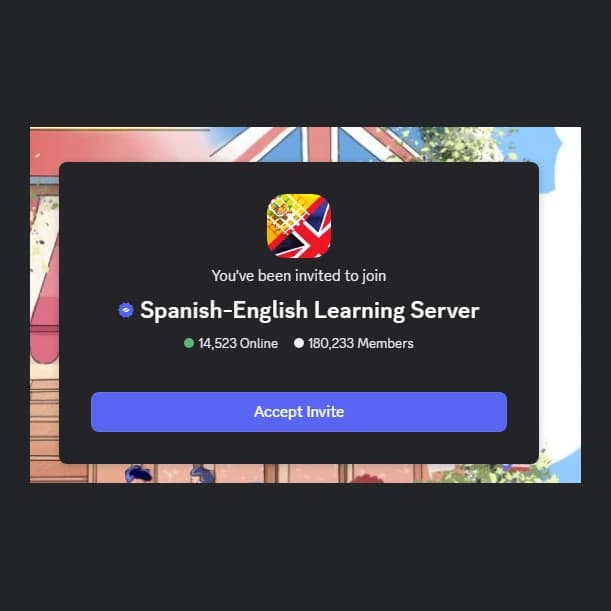




The hardest thing to find when you learn a language is someone to talk to. You can learn words from an app, but you only learn to say them by saying them to a person who knows when you got it wrong. I found a Discord server where native Spanish speakers listen to you read, fix every word you trip over and ask for nothing except a bit of help with their English.
Join the Spanish-English Learning Server on Discord at discord.gg/spanish-english. It's free. In its Lectura rooms you read a short Spanish text out loud while native speakers listen, and they correct you when you finish. Then you help them read English. The server also has voice chats where you speak Spanish to a native speaker and they answer in English.
Why speaking practice is the hardest part
Speaking practice usually comes from one of three places. You travel to a Spanish-speaking country, you have a friend who speaks Spanish, or you sign up for a class. That's a plane ticket, a lucky friendship or a monthly bill, and most learners have none of them on a Tuesday night. So their Spanish lives in an app and never gets said out loud.
Apps are good at the other parts. Duolingo builds the base (my piece on learning Spanish with Duolingo covers where it stops), and Lingopie trains your ear on real shows. Neither of them can tell you that your pero came out as perro and you just told someone “dog, I'm tired”. A person can, and on this server somebody is online at almost any hour, because they want the same thing from you in English.
The Spanish-English Learning Server
The Spanish-English Learning Server is a Discord community for two kinds of learners: Spanish speakers learning English and English speakers learning Spanish. The Spanish speakers come from Spain and all over Latin America. On the English side you'll find native speakers and plenty of fluent speakers from every corner of the world, and they help with English just as well.
How to join
You need a free Discord account, on your computer or the phone app, and a microphone. Open discord.gg/spanish-english, press Accept Invite and you're in. Before your first reading session, read the #how-to-join-lectura channel at the top of the reading section.
How a Lectura reading session works
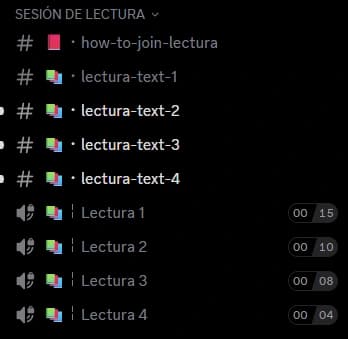
Lectura is Spanish for reading. Under Sesión de lectura in the channel list there are 4 voice rooms, Lectura 1 to Lectura 4, each with a text channel of its own. They come in different sizes: Lectura 1 fits 15 people and Lectura 4 fits 4.
A session runs the same way every time.
Join a Lectura room
Hop into any of the voice rooms, Lectura 1 for example. Somebody online sees you sitting there and joins. At busy hours the rooms are full before you even get there, so just pick another one.
Wait for one of each2 people minimum
A session needs at least one English speaker and one Spanish speaker. Once you have that, everyone presses Start.
Pick your level
Before your text shows up you choose Beginner, Intermediate or Advanced. If you speak English and you're learning Spanish, you get a Spanish text at that level. Not sure where you stand? My A1 quiz gives you a rough idea in a few minutes.
Read it out loud
The session tells you when it's your turn. You read the whole text while everyone in the room listens, native Spanish speakers included.
Get corrected, then pass it on
When you finish, people tell you which words you got wrong, how to say them and how well you did. You read the corrections again until they come out right. Then you press Next turn, and the next person picks a level and gets a text.
What the texts are like
Each text is about 200 words, picked at random, and reads like something a normal person wrote about their normal life. Here's a beginner one. Martha Rodríguez teaches fourth grade, she's 34, divorced, and has three kids. She gets up at six to prepare the day's lesson and reads the newspaper to find news she can bring to class. Three kids, a room full of nine-year-olds, and she still reads the paper before breakfast. On my days off I struggle to read the back of the cereal box.
That's the right kind of hard. The words are ones you'd use in a real conversation, about work, kids and getting up early, and the long sentences make you plan your breath like a swimmer.
How the corrections feel
Being corrected by a room full of strangers sounds like a nightmare. It isn't. Everybody in that room is about to read in a language that isn't theirs, so nobody is in a position to laugh at your rolled r. They tell you straight what went wrong and how well you did, you try the tricky words again, and the mood stays friendly the whole way through.
Then it flips. When a Spanish speaker reads an English text, you're the one with the good ear, and you get to explain why “thought”, “though” and “through” are three different words. Spanish speakers help English speakers read Spanish, English speakers help Spanish speakers read English, and everybody leaves owing everybody a favour.
Why reading out loud makes you better
In your head you can skim. You recognise a word, skip how it sounds and move on, and nobody ever finds out you've been saying it wrong for a year. Out loud, with native speakers listening, every wrong stress and swallowed syllable gets caught on the spot.
So you learn to read Spanish fast and smoothly, and most importantly, correctly. A word someone fixed for you in a Lectura room stays fixed everywhere you use it afterwards, in the next text, in a voice chat, at a bar in Sevilla.
Voice chats: you speak Spanish, they speak English
The reading rooms are half of the server. There are also Spanish and English voice chats, some capped at two people and some bigger. Join a Spanish voice chat as an English speaker and a Spanish speaker will join you. You talk to them in Spanish, they talk to you in English, and you both get exactly the practice you came for.
The two-person rooms are the gentle way in: one learner, one native speaker, and nobody else listening while you hunt for the word for “fridge”.
Turn the cameras on for comprehensible input
If you both agree, turn your cameras on. When you're stuck, you show the word with your hands, point at things, act it out, and the other person works out what you mean and gives you the Spanish for it. It's charades with a teacher on the other end, and a word you learned by watching somebody mime it is a hard word to forget.
Before your first Lectura
0 of 6
You make a ton of friends here
The same people keep turning up in the reading rooms, you start recognising voices and accents, and after a few sessions you're adding each other and talking outside the Lectura rooms too. Learners from all over the world, all stuck on the same thing from opposite ends. A Mexican who can't say “squirrel” and a Brit who can't say ferrocarril get along very well.
Add me on Discord
I'm on the Spanish-English Learning Server as sym473. Add me if you want a reading partner, or if you just want to say hola.